

Milliradian to Degree Converter (mrad to deg)
How to convert milliradians to degrees
To convert milliradians to degrees, divide milliradians by 17.453292519943
To convert degrees to milliradians, multiply degrees by 17.453292519943
Result Snapshot
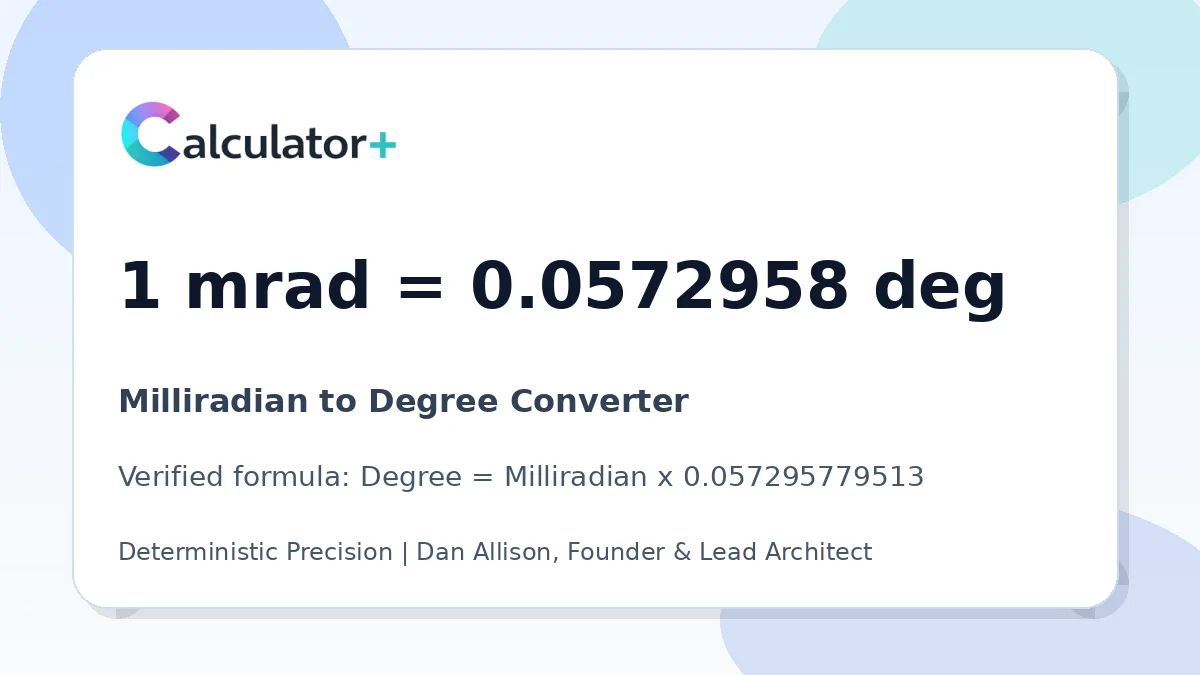
Common milliradian to degree examples
| Milliradian (mrad) | Degree (deg) |
|---|---|
| 1 mrad | 0.0572958 deg |
| 10 mrad | 0.572958 deg |
| 50 mrad | 2.86479 deg |
| 100 mrad | 5.72958 deg |
| 250 mrad | 14.3239 deg |
| 500 mrad | 28.6479 deg |
| 1,000 mrad | 57.2958 deg |
| 10,000 mrad | 572.958 deg |
| 100,000 mrad | 5,729.58 deg |
| 1,000,000 mrad | 57,295.78 deg |
Milliradian to Degree conversion formula
Output value = input value x (source-unit factor / target-unit factor).
Technical notation: y = x * (f_from / f_to).
For one milliradian, the calculator applies the exact stored ratio between milliradian and degree..
Variable key:
- Input value (x) = The source quantity entered into the converter.
- Output value (y) = The destination quantity returned by the converter.
- Source-unit factor (f_from) = How many radians are stored for one milliradian.
- Target-unit factor (f_to) = How many radians are stored for one degree.
Worked example for Milliradian to Degree
For one milliradian, the calculator applies the exact stored ratio between milliradian and degree.
This page uses a deterministic ratio model. It never estimates the answer from text patterns or rounded lookup tables. The visible result comes from the stored conversion factors in the unit library, which keeps the browser calculation stable across quick edits and reverse conversions.
- Choose the source unit Milliradian and the target unit Degree.
- Enter a value such as 100 mrad to produce a live browser-side result.
- Review the converted output and round it only to the precision your task actually requires.
About Milliradian and Degree
In this converter, 1 Milliradian is stored as 0.001 radians, and 1 Degree is stored as 0.01745329252 radians. That common reference basis is what makes the pair deterministic instead of descriptive.
Using a shared base unit prevents drift when a user changes direction or compares several target units from the same source unit. It also makes the page easier to audit because every result can be traced back to a single unit factor rather than a chain of approximations.
Angle conversions appear in surveying, navigation, drafting, machining, astronomy, and trigonometry. Users often need a converter because the same underlying direction or rotation is reported in degrees, radians, gradians, arcminutes, or arcseconds depending on the discipline.
Precision, rounding, and edge cases
The number displayed on the page is rounded for readability, but the conversion itself is based on the exact stored factor ratio for this measurement family. This matters on large values, very small values, and pages where the target unit is much coarser or much finer than the source unit.
If you are checking a textbook, spreadsheet, cadastral export, nutrition label, engineering note, or shipping sheet, match the number of displayed decimals to the precision of the original source rather than assuming every quoted result should be rounded to a whole number.
Where this conversion is used
Searchers usually reach converter pages when they have a narrow task to complete: normalize a measurement in a contract, compare vendor specifications, translate a classroom problem, check a field note, or recast a figure into the preferred unit system of the reader.
That is why the tool stays above the fold and the long-form content sits below it. The page acts first as a task-completion interface, then as a technical reference that explains why the conversion factor is valid and when precision choices start to matter.
Hidden variables and comparison risks
The most common hidden variable on linear conversions is not the formula but the unit definition. Close-looking units can differ by jurisdiction, standard, or historical convention. Examples include US versus imperial volume units, decimal versus binary digital units, and legacy survey definitions in land and distance work.
A second edge case is compound rounding. If the source number was already rounded before it reached this page, and the converted answer is rounded again for display, the visible output can differ slightly from a figure that was carried through at full precision from the original measurement.
How to report the result
Report the converted value with a unit label, not just a raw number. That matters when the result is copied into a spreadsheet, estimate, shipping note, procurement document, listing, or school submission, because numbers detach from their unit context very easily.
Choose the displayed precision based on downstream use. A classroom example may tolerate a short rounded answer, while a survey note, lab entry, or specification sheet may require several decimals so the converted number can be reused without introducing a second rounding error.
Cross-checking the answer
A simple audit check is to compare this pair against a nearby sibling unit in the same family. If acre to hectare and acre to square metre both align with the same underlying definition, the library is internally coherent rather than page-specific.
Another check is reverse conversion. Converting the output back into the source unit should recover the starting value apart from visible display rounding, which is exactly what a deterministic conversion engine is supposed to do.
Frequently asked questions
How many degrees are in 100 milliradians?
100 mrad equals about 5.72958 deg.
What is the milliradians to degrees formula?
Use output = input x (0.001 / 0.01745329252). That reduces to a forward factor of 0.057295779513 for this pair.
Can I convert degrees to milliradians too?
Yes. The calculator supports two-way conversion from the same tool interface. Editing either side recomputes the other side immediately using the same underlying unit definitions.
Is this conversion exact?
The converter uses fixed unit factors from the shared unit library. The visible answer may be rounded, but the underlying ratio used for the calculation is deterministic.
Why might another converter show a slightly different answer?
Small differences usually come from one of three causes: the other page rounded the factor more aggressively, it used a different regional unit standard, or it rounded an intermediate step before calculating the final answer.
How many decimal places should I keep when converting milliradians?
Keep enough decimals to preserve the precision of the original measurement and the context in which it will be reused. Classroom work, contracts, engineering notes, and listings do not always use the same rounding standard.
What is the main edge case for this type of conversion?
The biggest risk is usually unit-definition confusion rather than arithmetic. Similar-looking unit names can hide different standards, especially in area, length, volume, storage, and network measurements.
Related conversion pages
Related pages below keep the same measurement family in one crawlable hub. They are useful when you need the same source unit in a different target unit or want to validate a result against a second reference pair.