

Mile per US gallon to Litre per 100 kilometres Converter (mpg (US) to L/100 km)
How to convert miles per us gallon to litres per 100 kilometres
Fuel economy conversion may be inverse. This tool converts via km/L as a canonical step.
When converting to or from L/100 km, it uses the inverse relationship: L/100 km = 100 ÷ (km/L).
Result Snapshot
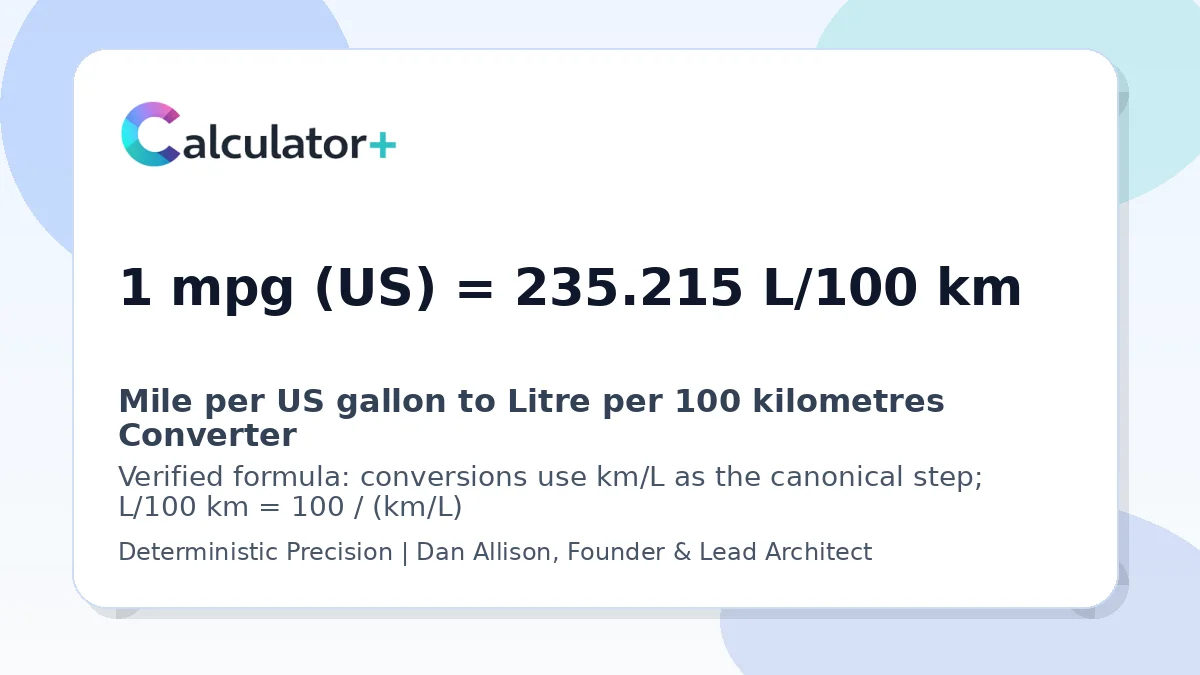
Common mile per us gallon to litre per 100 kilometres examples
| Mile per US gallon (mpg (US)) | Litre per 100 kilometres (L/100 km) |
|---|---|
| 1 mpg (US) | 235.215 L/100 km |
| 10 mpg (US) | 23.5215 L/100 km |
| 50 mpg (US) | 4.70429 L/100 km |
| 100 mpg (US) | 2.35215 L/100 km |
| 250 mpg (US) | 0.940858 L/100 km |
| 500 mpg (US) | 0.470429 L/100 km |
| 1,000 mpg (US) | 0.235215 L/100 km |
| 10,000 mpg (US) | 0.0235215 L/100 km |
| 100,000 mpg (US) | 0.00235215 L/100 km |
| 1,000,000 mpg (US) | 0.000235215 L/100 km |
Mile per US gallon to Litre per 100 kilometres conversion formula
The calculator converts the input into kilometres per litre as a canonical reference, then converts that canonical value into the target unit. When L/100 km is involved, the tool uses the inverse relationship rather than a direct multiplier..
Technical notation: Canonical step: km/L = input x factor. Inverse step when needed: L/100 km = 100 / (km/L).
The tool first normalizes the source fuel-economy value through km/L, then applies the correct forward or inverse rule for the destination unit..
Variable key:
- Input efficiency (x) = The starting fuel-economy value entered by the user.
- Canonical reference (km/L) = The internal comparison unit used to keep US, imperial, and metric outputs consistent.
- Inverse rule (100 / (km/L)) = Required when the target or source scale is litres per 100 kilometres.
- Output efficiency (y) = The converted fuel-economy value on the target scale.
Worked example for Mile per US gallon to Litre per 100 kilometres
The tool first normalizes the source fuel-economy value through km/L, then applies the correct forward or inverse rule for the destination unit.
Fuel-economy pages have a common failure mode in search results: many calculators mix up US mpg and imperial mpg, or they treat L/100 km as if it scales linearly. This page avoids that error by routing everything through one canonical measurement basis before publishing the answer.
- Choose the source unit Mile per US gallon and the target unit Litre per 100 kilometres.
- Enter a value such as 100 mpg (US) to produce a live browser-side result.
- Review the converted output and round it only to the precision your task actually requires.
About Mile per US gallon and Litre per 100 kilometres
Mile per US gallon and Litre per 100 kilometres belong to a measurement family with competing regional conventions. In automotive content, the unit name alone is often not enough because mpg can refer to either a US gallon or an imperial gallon.
That distinction changes the result materially. A trustworthy converter therefore needs both the unit label and the regional context built into the logic rather than inferred from user intent after the fact.
Precision, rounding, and edge cases
Rounding matters because published fuel-economy figures are often shown to one or two decimals, while engineering calculations may retain more precision. The page stores the full deterministic result and rounds only when rendering the visible answer.
When L/100 km is part of the conversion, better economy produces a smaller number rather than a larger one. That inverse behavior is the core edge case that many thin converter pages fail to explain.
Where this conversion is used
High-intent searches on fuel-economy pages typically come from vehicle imports, road-trip planning, spec-sheet comparison, fleet reporting, and automotive journalism. Users usually need a number they can quote immediately in the regional unit expected by the audience.
These pages also support cross-border buyers and sellers comparing EPA-style US figures against UK or EU-format listings, where a mislabeled gallon can change the apparent performance of the vehicle.
Hidden variables and comparison risks
The two hidden variables are gallon standard and inverse notation. US mpg and imperial mpg are not interchangeable, and L/100 km cannot be converted with a simple fixed multiplication in the same way as length or mass.
If a reference site disagrees with this page, check whether it is using US gallons, imperial gallons, or a rounded intermediary value. Those three differences explain most visible mismatches.
How to report the result
Fuel-economy results should be reported with the regional unit expected by the reader. A vehicle listing aimed at UK buyers may need imperial mpg or L/100 km, while a US auction listing usually needs US mpg.
If the number will be reused in a review, sales sheet, or fleet dashboard, copy both the unit label and the rounding precision together. A rounded mpg figure without clarification about gallon standard can mislead buyers and analysts.
Cross-checking the answer
One way to sense-check a fuel-economy answer is to convert it into a second common regional unit, such as km/L or L/100 km, and confirm that the result remains directionally sensible. Better economy should not become worse simply because the display unit changed.
Related pages for adjacent units are useful here because they let you compare US and imperial interpretations of similar labels without leaving the measurement family.
Frequently asked questions
How many litres per 100 kilometres are in 100 miles per us gallon?
100 mpg (US) equals about 2.35215 L/100 km.
What is the miles per us gallon to litres per 100 kilometres formula?
Fuel economy conversions are handled using km/L as a canonical step. When litres per 100 kilometres is part of the pair, the tool uses the inverse rule rather than a direct multiplier.
Can I convert litres per 100 kilometres to miles per us gallon too?
Yes. The calculator supports two-way conversion from the same tool interface. Editing either side recomputes the other side immediately using the same underlying unit definitions.
Is this conversion exact?
The converter uses fixed unit factors from the shared unit library. The visible answer may be rounded, but the underlying ratio used for the calculation is deterministic.
Why might another converter show a slightly different answer?
Small differences usually come from one of three causes: the other page rounded the factor more aggressively, it used a different regional unit standard, or it rounded an intermediate step before calculating the final answer.
How many decimal places should I keep when converting miles per us gallon?
Keep enough decimals to preserve the precision of the original measurement and the context in which it will be reused. Classroom work, contracts, engineering notes, and listings do not always use the same rounding standard.
What is the main edge case for this type of conversion?
Fuel economy conversions can be inverse when L/100 km is involved, and US mpg is not the same unit as imperial mpg.
Related conversion pages
Related pages below keep the same measurement family in one crawlable hub. They are useful when you need the same source unit in a different target unit or want to validate a result against a second reference pair.