

Kelvin to Fahrenheit Converter (K to deg F)
How to convert kelvins to degrees fahrenheit
To convert kelvins to degrees fahrenheit, apply the standard temperature scale formula.
For reverse conversion, use the inverse scale equation for degrees fahrenheit to kelvins.
Result Snapshot
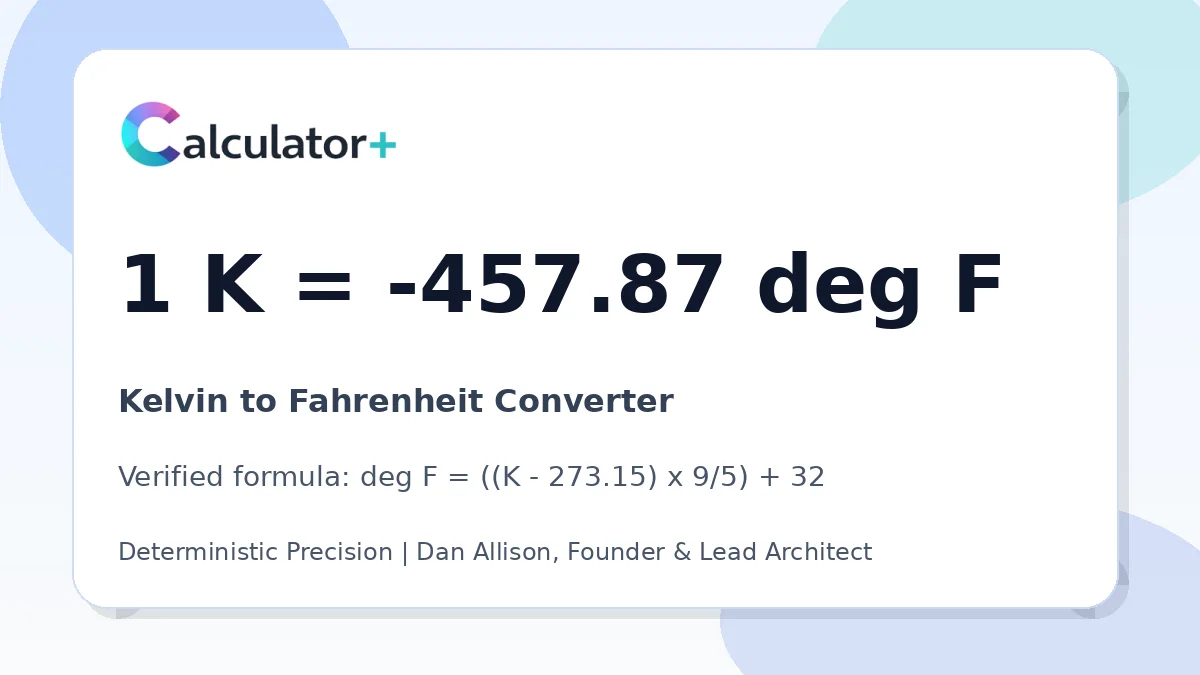
Common kelvin to fahrenheit examples
| Kelvin (K) | Fahrenheit (deg F) |
|---|---|
| 1 K | -457.87 deg F |
| 10 K | -441.67 deg F |
| 50 K | -369.67 deg F |
| 100 K | -279.67 deg F |
| 250 K | -9.67 deg F |
| 500 K | 440.33 deg F |
| 1,000 K | 1,340.33 deg F |
| 10,000 K | 17,540.33 deg F |
| 100,000 K | 179,540.33 deg F |
| 1,000,000 K | 1,799,540.33 deg F |
Kelvin to Fahrenheit conversion formula
Output temperature = ((input temperature - 273.15) x 9 / 5) + 32.
Technical notation: F = ((K - 273.15) x 9 / 5) + 32.
The calculator applies the standard kelvin to fahrenheit temperature equation and returns the result immediately..
Variable key:
- Input temperature (C, F, or K) = The starting temperature entered into the tool.
- Output temperature (Converted value) = The equivalent temperature on the target scale.
- Scale offset (32 or 273.15) = The constant required when a scale does not start at the same zero point.
- Scale ratio (9/5 or 5/9) = The proportional step size between Fahrenheit and Celsius.
Worked example for Kelvin to Fahrenheit
The calculator applies the standard kelvin to fahrenheit temperature equation and returns the result immediately.
Temperature is not a fixed-ratio conversion. Celsius, Fahrenheit, and Kelvin do not share the same zero point, so the tool must add or subtract an offset before or after scaling. That is why a dependable temperature converter cannot rely on a single multiplier.
- Choose the source unit Kelvin and the target unit Fahrenheit.
- Enter a value such as 100 K to produce a live browser-side result.
- Review the converted output and round it only to the precision your task actually requires.
About Kelvin and Fahrenheit
Kelvin and Fahrenheit are temperature scales rather than purely size-based units. They measure the same physical state but use different zero points and different interval structures.
This distinction matters in laboratories, HVAC work, food safety logs, weather reporting, and industrial monitoring. A ratio shortcut that works for metres or kilograms would be wrong for temperature whenever the conversion crosses an offset boundary.
Precision, rounding, and edge cases
Temperature results often appear with decimal places because the exact conversion may not land on a whole number. The calculator preserves deterministic accuracy internally and rounds only for display.
Negative inputs, freezing-point benchmarks, boiling-point checkpoints, and extreme cryogenic values all remain valid as long as the entered reading is physically meaningful for the scale being used.
Where this conversion is used
Common search intent on temperature pages includes recipe adjustments, appliance settings, HVAC diagnostics, weather interpretation, and lab record conversion. Those tasks require the user to trust that the offset was handled correctly, not just that the answer looks plausible.
Temperature pages also attract education traffic from people checking homework steps and professionals normalizing mixed-source readings before they enter a report, a support ticket, or a monitoring dashboard.
Hidden variables and comparison risks
The main hidden variable in temperature work is scale offset. A user who multiplies Celsius by 1.8 without adding 32 will systematically understate Fahrenheit results. The same logic applies to Kelvin conversions that must preserve the 273.15 offset.
If a third-party result differs from this page, the usual causes are premature rounding, a missing offset, or confusion between temperature intervals and absolute temperatures.
How to report the result
When you publish or transmit a temperature result, keep the original scale name with the number. A value without its unit is not actionable, and a value with the wrong scale label can create a serious interpretation error in maintenance, food safety, or laboratory work.
For operational contexts, copy the result at the precision required by the destination log or device rather than by the maximum decimals visible in the browser. A thermostat setting, a freezer alarm threshold, and a research notebook may each expect different rounding rules.
Cross-checking the answer
A strong way to validate a temperature answer is to compare it against fixed reference points such as freezing and boiling thresholds where appropriate. If the page output matches those benchmark relationships, the scale conversion is behaving as expected.
If you need a second check, convert the value back to the original scale. A trustworthy tool should return to the starting temperature apart from minor display rounding.
Frequently asked questions
How many degrees fahrenheit are in 100 kelvins?
100 K equals about -279.67 deg F.
What is the kelvins to degrees fahrenheit formula?
Temperature conversions use scale-specific formulas rather than a single multiplier. This tool applies the standard Kelvin to Fahrenheit equation and handles the scale offset directly.
Can I convert degrees fahrenheit to kelvins too?
Yes. The calculator supports two-way conversion from the same tool interface. Editing either side recomputes the other side immediately using the same underlying unit definitions.
Is this conversion exact?
The formula itself is exact for the selected scale pair. Visible decimals are rounded for readability, so a copied display value may show fewer decimal places than the internal calculation.
Why might another converter show a slightly different answer?
Small differences usually come from one of three causes: the other page rounded the factor more aggressively, it used a different regional unit standard, or it rounded an intermediate step before calculating the final answer.
How many decimal places should I keep when converting kelvins?
Keep enough decimals to preserve the precision of the original measurement and the context in which it will be reused. Classroom work, contracts, engineering notes, and listings do not always use the same rounding standard.
What is the main edge case for this type of conversion?
Temperature conversions are offset-based, so a simple multiply-only shortcut is not reliable.
Related conversion pages
Related pages below keep the same measurement family in one crawlable hub. They are useful when you need the same source unit in a different target unit or want to validate a result against a second reference pair.